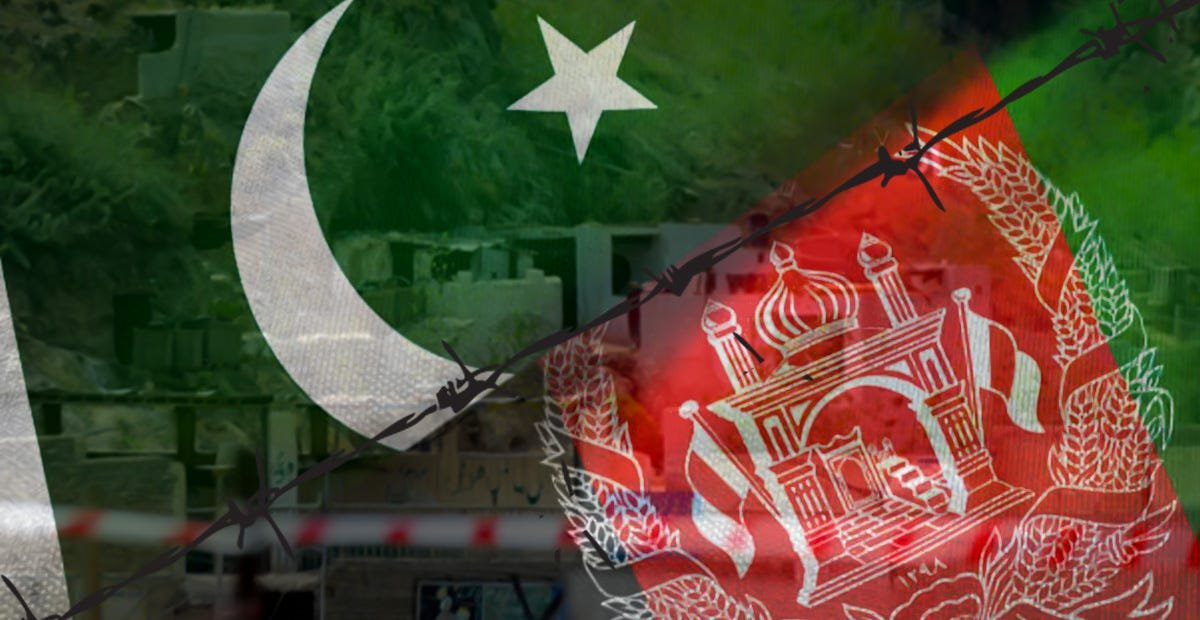
For forty years, Pakistan has faced a strategic problem that cannot be solved through military force alone: Pashtun identity. Not Pashtun militancy or insurgency, but the simple fact that 42 to 50 percent of Afghanistan's population and 20 percent of Pakistan's population share the same ethnicity, speak the same language, and maintain family and tribal connections that cross the Durand Line, a border drawn by Britain in 1896 that Kabul has never formally recognized.
This should be manageable. States manage ethnic diversity all the time. But the Pashtun problem is fundamentally different because it is cross-border. If Pashtun identity becomes politically organized across the Durand Line, if Pashtuns coordinate around shared ethnicity rather than state nationality, the very foundation of Pakistan's territorial integrity becomes unstable. This is not a hypothetical concern. It is an existential one.
For decades, Pakistan's response was crude: military operations, restrictions on movement, marginalization, suppression. But crude suppression creates martyrs and narratives of oppression. It creates the conditions for organic grassroots resistance that cannot be controlled because it was not created by the state. By the early 2010s, after a decade of U.S. military operations had devastated Pakistan's tribal areas, after hundreds of thousands had been displaced and tens of thousands killed, the conditions for authentic nationalist resistance had reached critical mass. Pakistan faced a choice at that moment: attempt to suppress resistance as it emerged, or create the resistance itself, control it from within, and ensure it fragmented rather than consolidated.
Pakistan chose the latter. The evidence is written in the pattern that followed, a sophisticated strategy that manufactures opposition, controls it through three coordinated components, and ensures that all political expression of ethnic identity remains fragmented and state-managed. A grassroots movement appeared at precisely the moment when organic nationalist resistance would naturally emerge. The timing was instructive: not before grievances had accumulated, not after they had already produced uncontrolled resistance, but at the exact moment when organic resistance was most likely to form. Instead of that organic emergence, a movement appeared with clear leadership, defined messaging, and apparent legitimacy.
The movement began with humanitarian demands: landmine removal, identification of missing persons, an end to military checkpoints. Apolitical on its surface, rights-based rather than nationalist, it built legitimacy and scale without immediately triggering an existential state response. Then, as it grew to mass scale with tens of thousands attending rallies and educated youth joining its ranks, something shifted. The rhetoric became explicitly nationalist. It invoked transnational ethnic solidarity. It challenged the border itself as an illegitimate colonial imposition. And here is where the state's response revealed the strategy: it did not crush the movement. It negotiated with it. It met with its leaders. It signed written agreements.
This is not how states respond to actual existential threats. A state genuinely threatened by a separatist movement does not permit mass rallies or negotiate with leadership. This is how states respond to movements they control. What followed was a pattern designed to maintain credibility without elimination. Arrests of leaders would occur. International attention would follow. The leaders would be released. They would reorganize. Arrests would occur again. The cycle would repeat. When the movement was eventually banned, it did not disappear. It survived the ban, reorganized despite restrictions, and continued operating. A destroyed movement is no longer useful to the state. A banned movement appears dangerous to international observers while remaining controllable domestically.
The movement serves multiple critical functions. It provides a pressure valve by channeling ethnic grievances into acceptable forms, preventing more radical movements from emerging. It functions as an intelligence apparatus, identifying and profiling actual nationalist voices before they can build independent power bases. It manages international narratives, allowing the state to point to the movement as proof of openness and democratic space when foreign observers ask about ethnic rights. But the deepest function is transnational: the movement invokes a concept of cross-border ethnic solidarity that resonates with the ethnic population across the border, building genuine transnational consciousness. Because the movement is controlled by the first state, however, the neighboring state cannot mobilize it for its own strategic purposes. The solidarity is real. The political coordination is prevented.
While grassroots outlets channel popular grievances, a second component manages elite nationalism. Parliamentary politicians, party leaders, and institutional figures appear to represent nationalist interests. They advocate for ethnic rights, provincial autonomy, fair resource distribution. They contest elections and hold parliamentary seats. The rhetoric is nationalist. But examine the structure carefully: family members hold state positions. The nationalist leader and the state official are integrated, not opposed. One brother represents ethnic nationalism in parliament while another represents the state in government. They coordinate. This is not infiltration. This is integration.
The structure accomplishes what grassroots cannot. It shows the ethnic population that they can advocate for their interests while remaining loyal to the state. You can be nationalist and successful. You can invoke ethnic identity and hold high office. You can meet with foreign officials and discuss cross-border concerns as long as you operate within state-defined parameters. This is co-option. The state permits nationalism to exist and even to thrive as long as it operates through approved channels. The message is clear: there is a pathway to power, and that pathway requires loyalty. The alternative, independent organization and grassroots resistance, leads to imprisonment.
When geopolitical conditions shift, the elite component pivots. A nationalist politician becomes a bridge to a neighboring government. An alternative voice becomes a state intermediary. His function shifts from providing opposition to managing bilateral relations. The pivot reveals where actual loyalty lies. Throughout both components, a unifying concept threads through all organized expression: a slogan calling for ethnic unity across the border. It is powerful because it directly challenges the legitimacy of the border, saying that one people divided by an illegitimate colonial line should transcend state boundaries. This is the most threatening concept to the first state's security doctrine. Not because it calls for immediate rebellion, but because it asserts a political reality that contradicts the state's foundational claim: that the border is legitimate and should define ethnic identity.
If this concept became an organized political force and if the ethnic population coordinated across borders around it, the implications would be destabilizing. Demands would follow for border opening, resource sharing, cross-border political organization, or potentially unification. The state's territorial claims would face internal challenges from the largest ethnic group in those regions. The state's response is to not suppress the concept but to control it by ensuring every significant voice invoking it operates through state-controlled channels. The concept remains aspirational rather than political. It can be felt and expressed but not become organized.
The grassroots movement invokes it. The elite politician references it. It threads through both, appearing to represent genuine transnational consciousness, but all organized expression is captured by state actors. The concept never becomes a unified political force because all the voices claiming to represent it are under state control. The result is that the concept exists as a powerful emotional and cultural identifier. Every member of the ethnic group invoking it feels the truth of it, but that feeling is channeled through state-controlled movements and state-integrated politicians. It never becomes political power.
The evidence for this coordinated apparatus is the pattern itself. Not leaked documents or confessions, but the pattern of timing, causality, and strategic function. In the moment when organic ethnic nationalist resistance would naturally emerge, a grassroots movement appears with leadership and messaging. As it grows to mass scale, an elite nationalist component appears with family integration into state structures. When regional conditions shift, the elite component pivots to serve state interests in the new landscape. Throughout, a unifying concept threads through both movements, suggesting transnational consciousness while ensuring all organized expression is captured.
If this were organic and uncoordinated, the state would crush the grassroots movement decisively when it reached mass scale. Genuine suppression is total, not cyclical. The elite nationalist could not simultaneously hold independent political position while family members hold high state office. This is not coincidence. This is integration. The unifying concept would have become a political movement by now, organized across borders and making concrete demands. The fact that it remains purely aspirational, invoked only by state-controlled actors, suggests it is managed. Instead, all three components exist in precise balance, all serving the strategic function of fragmenting ethnic consolidation. The timing of emergence, the coordination of functions, the adaptation to changing conditions all suggest orchestration. This is proof in an analytical sense. The pattern reveals strategy.
A neighboring state attempting to build a unified, multi-ethnic national state faces a structural problem: the neighboring state controls the organized expression of the shared ethnic identity on its side of the border. For the neighboring state to build truly unified governance, it requires prevention of ethnic identity being weaponized to fragment the state, acceptance by the shared ethnic group of power-sharing within a multi-ethnic framework, and a sense that national identity supersedes ethnic identity. The first state has made all of this nearly impossible by controlling all organized ethnic voices on its side. If the shared ethnic population invokes the transnational concept, they are invoking something managed by state actors from the first state. If they seek solidarity with co-ethnics across the border, they are seeking solidarity with individuals under the first state's control. If they attempt to organize cross-border political action, they are organizing with state agents.
The neighboring state cannot use shared ethnic identity as a foundation for national consolidation because that identity is cross-border and the first state controls the expression on its side. Even if the neighboring state shares ethnicity with the largest ethnic group, it cannot consolidate that group into unified national support because the first state's controlled movements prevent independent coordination. And the neighboring state cannot prevent this through military response because the interference operates through political channels, not military ones. It is not invasion. It is management of ethnic political expression through controlled movements and integrated elites. It is sophisticated, deniable, and effective in ways that military force could never be.
For this strategy to work, it must remain unnamed. It must appear organic. The grassroots movement must seem like genuine resistance the state struggles against. The elite politician must appear as an independent voice the state must tolerate. The transnational concept must seem like a natural expression of ethnic consciousness. But when you examine the pattern, the timing, the coordination, the strategic functions of each component, the appearance dissolves. What remains is architecture. Sophisticated state capture of opposition. Manufactured dissent designed to prevent genuine dissent. Controlled nationalism designed to prevent unified nationalism.
This is not theory. This is practice. This is how states prevent neighboring state consolidation without military force. The sophistication is in the appearance. The strategy is in the pattern. The proof is in how all three components work together to produce one outcome: the prevention of ethnic consolidation and the indefinite maintenance of state leverage over a neighboring territory. Understanding this apparatus is the first step toward defeating it.